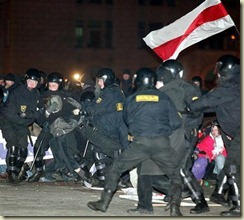
Showing posts with label Belarus. Show all posts

Thursday, 5 January 2012

Then they came for the internet

As for so many dictators around the world, 2011 was a bad year for ageing Belarusian despot Alexander Lukashenko, with the mass streets protests ignited by his rigged re-election in the dying throes of 2010 rumbling on, despite violent retaliation by security forces and the arrests of high profile dissidents. 

Belarus protest against LukashenkoIn April a bomb attack on a Minsk station, attributed by the authorities to a vague entity called the Belarusian National Liberation Army, was used as the pretext for further crackdowns, with Lukashenko calling on his thugs to “bring in everyone and interrogate them” and to “pay no attention to democracy.” 

However, he categorically failed to rally the Belarusian people and the international community behind him and speculation that his own forces had a hand in the atrocity still lingers.  The fact that the two men accused of the bombing and subsequently sentenced to death were not accorded anything resembling a fair trial did nothing to dispel this theory.

Now, a year into his fourth term as President of Europe’s last dictatorship, Lukashenko is launching a fresh attack on his people’s liberties, by implementing a law that imposes unprecedented new restrictions on their internet access.  WhilstLukashenko Europes last dictator claims that the legislation will effectively amount to a ban on foreign websites have been hotly disputed by those who attest it is merely an economic measure mainly targeting business with online shopping sites hosted outside Belarus, there is clearly a political motive to the move.  

For one thing, the new law will oblige service providers and internet cafes to "record and store...personal data of internet services users and information about the internet services that have been provided."  It also bans websites deemed to be “extremist” and use of the internet for “promulgating [any] acts prohibited by the law” – leaving the definitions ambiguous and subject to interpretation by the authorities. 

Given the laws against demonstrations and the frequent classification of pro-democracy groups as dangerous extremists, it seems almost inevitable that it will be activists and their supporters who are ultimately targeted and punished.

And that Lukashenko should seek to tighten internet access should come as no surprise.  Opposition sites and social media sites were both blocked during protests last year and in December the dissent news site Charter 97 (the founder of which was murdered in 2010) was shut down by a cyber attack.  It was only a matter of time before he tried to undercut the online groundswell that helped to facilitate the most challenging year of his rule.

Laptop chained Belarus internet censorship

Sunday, 3 July 2011

Lukashenko under pressure

It has been almost three months since Belarusian dictator Alexander LukashenkoBelarus Police used a mysterious bomb attack as a pretext to crack down against mounting opposition to his autocratic rule.  Calling on his infamous secret police to "bring in everyone and interrogate them, pay no attention to democracy or the groans and howls of the foreign martyrs" –he pushed back against the country’s increasingly active democracy movement, hoping to dampen the protests that surrounded his rigged re-election before being strengthened by the inspirational uprisings of the Arab Spring.

He failed.

The protests have continued to grow, new tactics are being utilised by the opposition and criticism from the international community is getting louder.  Last month activists used social media sites to arrange a silent protest in Minsk – showing their opposition to Lukashenko without the kind of chants, slogans or banners that would normally result in arrest.  The trend rapidly caught on but subsequent gatherings have been violently broken up in front of international media.  Belarus silent protestThe embarrassed and embattled dictator –clearly shaken by the demonstrations – which have drawn as many as a thousand mainly young activists-swore to prevent a similar initiative designed to disrupt his Independence Day speech. 

Demonstrators had planned orchestrated applause to drown out Lukashenko as he began to address the crowds at todays proceedings, yet his authorities aimed to hamper this by blocking social media sites and detaining numerous democracy leaders including Stanislav Shushkevich – a prominent former government official.  Those who did applaud “too enthusiastically” were dragged away by police – quite possibly to face the kind of brutal torture for which Lukashenko’s regime is infamous. 

Such actions show just how afraid he has become and draw further international attention to the democracy movement.  Whilst he sought to use the April bombing to gain sympathy or even support for his rule, he has today undermined any semblance of a publicity coup by showing true colours once more: an unhinged despot leaning towards Chinese-style censorship of the internet and actively endorsing the detention of those who applaud him or stay silent.

Tonight the strain is already starting to show.  Though Russian troops took part in the Independence Day parade, illustrating the officially solidarity of Belarus’ powerful neighbour, Russian state TV which is available in Belarus and normally sympathetic to Lukashenko, showed democracy activists being roughed up by Belarusian police, spreading publicity and sympathy for the protests.  Shushkevich has also been unexpectedly released, potentially due to a combination internal and external pressure.

With the country facing its worst economic crisis in decades and popular demonstrations continuing against other violent regimes throughout the world, Belarus’ protest movement has even more impetus to enhance its growing momentum.  Now, support from elsewhere –particularly through pressure on Russia, an economic squeeze on the government’s assets and practical aid for the demonstrators in their use of new media is essential, and could genuinely help the brave men and women seeking to bring down Europe’s last dictatorship from within.

There is still a long way to go, but in these turbulent and exciting times, Lukashenko is looking shaken and afraid.  The six months since his sham re-election have been incredibly trying for the aging tyrant…the coming months will surely be even more so.

Lukashenko under pressure

Wednesday, 13 April 2011

Lukashenko, Belarus and the mystery bomb

Belarus BombThe only thing currently clear about Monday’s terrorist attack in Minsk is its savagery. At the height of rush hour in one of the Belarusian capital’s busiest stations, the bomb packed with nails and ball-bearings for maximum damage, killed twelve and wounded some two hundred more. Amongst the shocked and devastated mourners two questions are now ringing out: who did this – and why?

The confusion is underscored by the fact that Belarus, Europe’s lastBelarus Police dictatorship, faces barely any active terrorist threat. The mainstream democratic opposition movement is almost invariably on the receiving end of political violence,facing beatings, imprisonment and torture in response to their peaceful protests. Islamic extremism, unlike in neighbouring Russia, is hardly on the radar. And domestic neo-fascism, though potentially a rising force, has yet to spawn any group capable of this kind of attack, which would nevertheless be out-of-keeping with such ideology considering that the majority of victims were inevitably white Belarusian commuters.

Belarus has seen previous bomb attacks, in 2005 and 2008, apparently the work of a fringe group opposed to dictator Alexander Lukashenko, calling itself the Belarusian National Liberation Army. However, between these two incidents there was no sign of the organisation and its very existence remains questionable. The fact that both occasions were followed by crackdowns on the mainstream opposition, has long led to murmurings of ‘false flag' operations ordered by Lukashenko himself. It is easy to see how such suspicions come about; after all this latest attack is certainly working in the dictator’s favour. The combination of international sympathy, domestic anger and widespread confusion will only help him to counter the growing external pressure and active democracy movement as well as the images of of Arab revolutions being broadcast in from European TV stations.

Within 48 hours of the blast, the KGB (as the state secret police is still known) had detained two suspects who have now admitted to the attack, something that means little in a country were confessions are obtained through breaking bones and leaving detainees in sub-zero temperatures. They were also quickly blamed for the 2005 and 2008 bombs, whilst Lukashenko publicly announced that a full scale ‘mop-up’ of opposition would take place, instructing his thugs to "bring in everyone and interrogate them, pay no attention to democracy or the groans and howls of the foreign martyrs." He also used the bombing as grounds to attack the continuation of EU sanctions on Belarus, in place since he extended his rule through a rigged election last year.

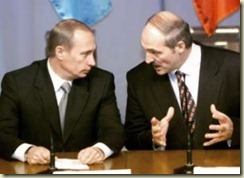
Of course, political gain from an incident does not imply guilt, as is obvious from numerous examples such as the Chinese government’s use of the post 9/11 climate to launch crackdowns in East Turkestan. It is also wise to be cautious of the kind of conspiracy theories that follow almost every major terrorist attack. Yet still, the overwhelming lack of knowledge or evidence regarding the Belarusian National Liberation Army- even within a police state, combined with the absence of any other likely culprit and the vast, immediate nature of political capitalisation Putin and Lukashenkoby Lukashenko, naturally leads to questions over his involvement – or at least his prior knowledge of this barbaric act. His strong links to Putin – a master of using apparent Chechen terrorism for political gain should also not be overlooked. It is now widely presumed, if not generally accepted, that the Russian PM had a hand in the 1999 apartment bombings that help catapult him to power; a theory reinforced by the murder of dissidents articulating it - including former spy Alexander Litvinenko. That Lukashenko may have taken a leaf out of Putin’s book may not be such a far-fetched idea.
For a man known to imprison and starve those opposing him, who maintains the legal mechanisms to execute dissidents and who detained hundreds of pro-democracy demonstrators at the close of 2010 – would adding state terrorism to his repertoire really be that implausible?


Technorati Tags: ,,

Friday, 21 January 2011

Five more years of pain?

belarus4Last month I wrote about the pro-democracy protests that were rocking Belarus in the wake of Alexander Lukashenko’s rigged re-election. Back then it looked as if the resistance could reach critical mass and imperil his sixteen year old dictatorship. However, like so many democratic uprisings, it has been ruthlessly crushed by security forces and its lead players have been thrown into jail. Tragically the people of Belarus were unable to succeed where the people of Tunisia so spectacularly did just a few weeks later.

And so today Lukashenko was formally sworn in as President once again and began his fourth term in office. In many ways it is aLukashenko2.jpg strange throw-back to days of the USSR, when ruthless European dictators were regularly shoe-horned into power as their political opponents were beaten and imprisoned. The geopolitical similarities run far deeper: the Russia-Belarus Union State originally formed in 1996, has been the subject of renewed enthusiasm by Lukashenko, Putin and Medvedev in recent years, including talk of developing it from a regional political grouping into formal unification.

However, there are also significant differences from the Cold War days that provide the European community with critical opportunities to aid the Bealruasian people in their struggle for human rights and freedom. Lukashenko’s current Russian patrons are nowhere near as powerful as their Soviet predecessors –nor are they unfalteringly supportive of his regime. Over the pasts weeks an economic spat over energy prices has driven a clear political wedge between the two states that, if exacerbated, could leave Lukashenko estranged from his only true ally. Even if this specific incident is ultimately resolved, it is not beyond comprehension that future disputes could dampen long-term Russian support for Lukashenko.

The 58 year old tyrant may accordingly turn away from Moscow somewhat and gradually look towards the rest of Europe; providing an historic chance to influence him. Of course whilst any such chance should be seized, it must also be handled with extreme care. Firstly, efforts for democratic reform should be led by Belarus’ immediate neighbours- lest the perception of ‘Western European interference’ isolates Lukashenko or antagonises Russia. Secondly these efforts must be correctly targeted; for example specific sanctions on the dictator and his close associates until measurable targets are met will be far more effective than indefinite economic sanctions that could inadvertently harm the Belarusian people.

Already there are positive developments along these lines, including the unilateral travel ban imposed by Poland on Belarusian government officials. If this was adopted by other European states- with the promise of lifting it when the detained oppositions candidates and those arrested during the protests are released - it would be hard for Lukashenko to ignore. Other devices including bank account freezes could be combined with high-level dialogue and summits to secure results such as protest rights, Red Cross access to political prisoners and moves away from the death penalty.

Making Belarusian rights an issue in negotiations with Russian authorities, especially during trade negotiations, could also provide a valuable channel for influence, allowing for progress even if Lukashenko’s relationship with the Kremlin returns to its usual amicable state. This is a long shot fraught with issues, but it its not beyond comprehension that given the right circumstances and negotiation Russia may provide something of a route towards progress rather than an outright obstacle. If nothing else this is an avenue worth exploring.

Then again – the inevitable change may not come from ‘above’ at all. Although many of those leading the demonstrations back in December are now locked away from the eyes of the world- most likely suffering from the beatings, starvation and denial of medical care prevalent in Belarusian jails – their inspirational acts have reverberated across the nation. December’s protests were the largest in decades and with the grievances wholly un-addressed a repeat is by no means off the cards. What’s more, the security forces have only been able to detain a tiny fraction of the tens of thousands who took part – there are many new leaders still out there and many more prepared to follow them. Sooner or later Europe may see its very own Tunisia moment.

belarus 5

Sunday, 19 December 2010

A turbulent night in Europe’s last dictatorship

Belarus has many claims to fame, like the Belavezhskaya Pushcha- Europe’s final vast ancient forest; or the Mir Castle Complex- a stunning UNESCO world heritage site. However, it more often than not stands out because of the fact that – almost eleven years after it gained independence from the Soviet Union, Belarus’ 9.5 million people still languish under a dictatorship……the last in Europe.

With this goes a host of other unique yet grossly undesirable titles – like the only European state to retain the death penalty and the lowest ranked European state in Freedom House’s Freedom in the World Report. The ruling regime has also come under frequent criticism from an array of international organisations including Human Rights Watch, Amnesty and Forum 18 as well as numerous foreign governments.

The criticism is well-merited. Dictator Alexander Lukashenko has held power since 1994 through a series of rigged elections interspersed with the imprisonment and torture of opponents, suppression of civil society and politicisation of the security services. From their violent treatments of detainees to their Soviet-style control of the media Lukashenko and his thugs have consistently shown the abhorrent measures they will take to ensure the continuation of authoritarianism in this corner of an otherwise democratic continent.

However, brave Belarusians continue to stand up to the regime and tonight are taking to the streets of Minsk to oppose the results of Lukashenko’s latest sham election; which returned him to power with a ‘70% share of the vote’ after widespread voter intimidation, media manipulation (and if the events of his past elections are anything to go by – mass ballot rigging.)

Reports coming out of the country over the last few hours indicate that even after riot police violently broke up a protest denouncing the outcome, ten of thousands of demonstrators re-grouped with some attempting to storm the government headquarters. The latest news is that they have been pushed back and hundreds have been detained……but despite enduring one of its coldest winters, Belarus is witnessing public political upheaval on a scale not seen since the first few years of Lukashenko’s dictatorship.

The next few days will undoubtedly be crucial ones for the future of this nation that has suffered for so long. For the Belarusian people this may turn out to be an historic turning point. For Lukashenko – he may be about to realise that rigging the election was the easy part…

Belarus