Showing posts with label Conservatives. Show all posts

Monday, 13 June 2011

Aid to India - the bigger picture

After months of lobbying and negative press from elements of the political right, the UK government has announced its intention to cut or terminate aid to India. International Development Secretary Andrew Mitchell's announcement this week that the Indian part of the UK's programme has been frozen and that he could not see it continuing "for very much longer" drew gloating cheers from those who argue that a nation with a space programme, nuclear weapons and a growing number of millionaires should not receive handouts from the developed world.

Their simplistic celebrations however, overlook the bigger picture - which is far more nuanced that they appear to comprehend. India has a chronic poverty problem -with more impoverished people than the entirety of Sub-Saharan Africa. And the fact that successive governments have failed to adequately address this should not prevent other states seeking to improve the lives of those suffering.

After all international aid is not dependent on the financial sense of governments in those states receiving it. Much of the time it is about direct assistance to those suffering precisely because their own governments are too wasteful, corrupt or selfish to do so. If aid to impoverished Indians is cut on the grounds that the Indian government wastes resources on space flights or nuclear warheads, then most other UK aid programmes must join it on the scrap-heap. After all Mugabe's government wastes money of killing democratic dissidents, Thein Sein's government wastes money on slaughtering members of ethnic minority groups and Mahinda Rajapaksa's government wastes money on war crimes in Tamil Eelam.

The important thing is to ensure that direct aid reaches those in need (whilst of course pursuing political change) rather than write off any potential of helping the most unfortunate people on the basis that a domestic political elite practicing good governance would be able to sort the problems 'in house'.

Beyond this, the language used by those who endorse cutting aid to India reveals a startling amount about their true motives and risks even more dangerous precedent-setting. Increasingly the apparent injustice of giving aid to "rich" India, is mentioned in the same breath as financial cuts and poverty "at home". This implies an "us-and-them" or "charity begins at home" mindset, threatening popular support for the government commitment to continue international aid spending at 0.7% of GDP and to the admirable campaigns to increase this measly figure to 1%. Ultimately India and its wasteful space programme are being used as poster boys for people who would like to see a roll back of the progress made over previous decades and have international aid once again relegated to an afterthought.

Here too they miss the real picture: the importance of international aid for global security, the horror of people starving to death or dying of easily preventable diseases, the pain felt by children who have not drunk water for days or of mothers who inadvertently infect their young with HIV through their breast milk. We are facing huge issues relating to homelessness, debt, child poverty and inadequate housing in the UK -but earmarking 70p of every £100 in the national coffers for the entirety of the developing world is very little indeed: even £1 in every £100 barely seems enough.

India -like many nations- has a wasteful government. And India- like many nations - has millions of people whose living standards are so low, those of us lucky enough to live in the UK could barely imagine them. We need to make sure UK development programmes work - that they aren't hampered by corruption, that they reach those in need, and that they are targeted and efficient enough to make a real difference. But beyond anything else we need to help those in poverty - by enhancing or improving our aid - not by cutting it.

Saturday, 2 October 2010

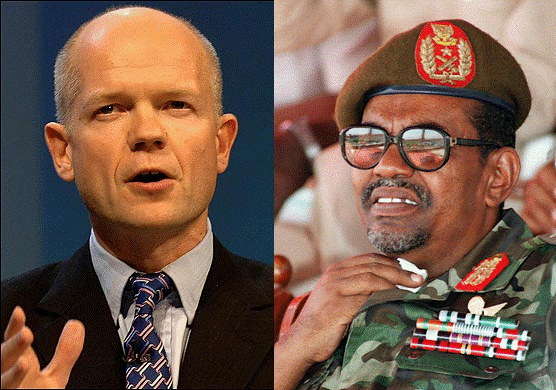
The Tory and the War Criminal

Back in April I wrote an article discussing the kind of Foreign Policy a Conservative Government might adopt. At the time I highlighted William Hague’s strong stance on states such as Burma and Zimbabwe, as well as the hugely positive work of the Conservative Human Rights Commission; but expressed concern about the party’s overall position, not least due to their manifesto statement that “foreign policy is above all about the protection and promotion of our national interest, and will be crucial in charting Britain’s path out of recession” –a thinly veiled indication that trade would trump everything, including human rights.

Just under six months on, these fears have been confirmed. Last Wednesday, senior government officials and business leaders hosted a delegation of indicted war criminal Omar Al-Bashir’s cronies, to discuss the facilitation of UK investment in Sudan. Ignoring the charges of genocide in Darfur levelled against Al-Bashir by the International Criminal Court, and his government’s continued hindrance of the referendum on Southern-Sudanese independence scheduled to take place early next year (the kind of hindrance that could feasibly trigger civil war); William Hague and his advisors have seen fit to economically get into bed with the tyrant.

Predictably they have trotted out the age-old line (or should that be “lie”?) that investing in authoritarian states gives you a degree of influence over their politics; and that consequently through deals such as this, the UK can help to stop the genocide (which has so far claimed between 300 000 and 400 000 lives) whilst ensuring a smooth referendum come January. In reality nothing can be further from the truth: dictators such as Al-Bashir are swayed by money and power, not the moral prophesising of their trade partners, so investing with them will only serve as tacit endorsement of their actions.

The potential of trade should be used as an incentive to reform, and only offered up once real, tangible improvements have been made. True, some will argue that Hague & Co’s investment programme will leave them with the option to withdraw if Al-Bashir continues to slaughter those under his control, but no one can seriously envisage this actually happening.

A further issue lies in the way that UK investment undermines attempts at coordinated strategies to deal with Sudan. Such complex human rights situations require the most globally-joined-up approach possible to make any real headway, rather than various states and international bodies each taking different, contrary approaches. Instead, the UK is striking trade deals whilst the US imposes sanctions; and Al-Bashir is subjected to an arrest warrant from the International Criminal Court, whilst his men are welcomed as honoured guests in London. This is utterly counter-productive.

Right now it seems that the Conservative Human Rights Commission has been shafted, the Lib Dems as junior coalition partners are silent, and Hague is pursuing a policy of financial gain rather than humanitarian values. It looks like the activists are going to have their work cut out.

Monday, 16 August 2010

When cuts can kill

You shouldn’t believe everything you read in the papers, but recent reports of a leaked memo, concerning huge proposed government cuts to aid spending, are a rightful cause for alarm. In the memo, which ministers have been incredibly (and some would argue conspicuously) silent about, DFID’s director of policy suggests that numerous programmes including those relating to polio eradication and primary education in the developing world should be canned. It goes on to outline strategies for dealing with challenges to such moves and suggests targeting those projects which were “unlikely to be noticed.”

If the leak alone wasn’t embarrassing enough for the government, it came just days before Ban Ki Moon called on the world to provide more aid to help those caught up in the apocalyptical humanitarian disaster unfolding in Pakistan.

The UN Secretary General is right of course; governments in the developed world should be doing much more to help deal with what is rapidly turning into one of the worst natural disasters in recent history, but so too should they be doing much more to help all those in poverty across the globe.

The moral case for this is undeniable. Whilst poverty obviously affects those in our own country (as the brilliant Disposed Appeal currently being run by the Evening Standard has so vividly highlighted) this is nowhere near as widespread nor as critical as the many, many states where clean water, basic foodstuffs and even the most rudimentary shelter are all sparse luxuries for literally billions of people.

In addition to this, there is also a strategic argument for increased aid spending. Providing food, medication and the like to people in places such as Somalia, Pakistan and Afghanistan reduces the appeal of extremist groups seeking to recruit their next batch of trainees. After all – why would you wish to harm states such as the UK or USA if they were the ones who provided lifesaving medical care for your HIV infected child or food for your starving wife? This is, of course, a broad simplification but the principle has been demonstrated both positively in cases where aid delivery has been quick and effective; as well as negatively, when militant groups have filled the relief void.

The coalition government’s apparent plans to slash aid spending are therefore politically ludicrous as well as morally bankrupt. They also threaten to rescind the promises in both the Conservative and Liberal Democrat manifestos, that aid spending would be increased to the UN-recommended level of 0.4% (a figure in itself inadequate).

If last week's reports are based on misinterpretations or skewed facts, the government must respond by immediately outlining their spending plans in this area and providing the electorate with guarantees that their promises during the election will be kept. If however, the reporting is accurate, then we must urgently and unequivocally call on our elected representatives to do everything in their power to prevent moves towards reducing aid projects.

Widespread cuts will be tough for everyone; but when it comes to the aid budget they can kill.

Sunday, 11 April 2010

Will the Tories change the world?

Almost a week into the election campaign the focus is still firmly on the economy. The debate over tax breaks for married couples showed a few dividing lines between the parties in terms of social standpoints but the emphasis remains on the financial side. Cuts, spending and saving policies are the order of the day.

It'll probably be that way for the next couple of weeks but things will change on April 22nd when Sky holds the televised leaders debate on foreign affairs. This is the one that really interests me. I guess the big question is: if the Conservatives win on May 6th will the UK's foreign policy significantly change?

In terms of human rights and foreign development - key electoral issues for a lot of activists - there are some promising signs. The Conservative Human Rights Commission, set up to guide the party's foreign policy down a pro human-rights path, has taken a strong line on issues such as Burma, modern day slavery, child soldiers and the use of rape as a weapon in war. Some of the Commission's senior members, such as Benedict Rogers, are amongst the most committed human rights activists in the UK and they've worked closely with NGOs such as Human Rights Watch and Amnesty to formulate feasible and robust policy proposals.

There are also signs that William Hague will take human rights issues seriously if he becomes Foreign Secretary; he's been tough in his criticism of the Burmese dictatorship and in 2008 called on the government to withhold recognition of Mugabe's regime after Zanu-PF violence forced Morgan Tsvangirai out of the presidential race. To top it off the Tories are committed to increasing international aid to 0.7% of the GDP (including £500 million to fight malaria) and to setting up an Independent International Aid Watchdog to monitor the Department for International Development's performance.

Could this be a welcome change from a Labour stint marked by a very dubious record on human rights? Certainly the current government's complicity in torture, silence on human rights violations in Saudi Arabia and recognition of Chinese sovereignty over Tibet amongst other issues have led many activists to believe that it is time for a change. The sacking of Craig Murray over revelations about UK’s work with Karimov’s regime in the ‘War on Terror’ was another key sign that Labour’s support for human rights hit a cut-off point when strategic interests are at stake.

But how different would a Conservative administration be? The Conservative Human Rights Commission is a very good initiative - there is no doubt about that. But there is a question about how much those at the top of a Tory government would listen to its recommendations. While the Commission asserts that "freedom and human dignity should be at the heart of foreign policy" the official Conservative website suggests that "Foreign policy is above all about the protection and promotion of our national interest, and will be crucial in charting Britain’s path out of recession." The emphasis on UK interests and the economy suggests that (like the current government) financial gain could trump human rights concerns.

It's unlikely, for example, that a Conservative government would risk loosing British jobs over criticising the Saudi government's execution of homosexuals and use of torture. In fact, David Cameron met King Abdullah when he visited the UK and showed no sign of raising human rights concerns. Similarly the party’s desire for a "strong and effective relationship with China" suggests that, whilst the Conservative Human Rights Commission displays a link to Free Tibet on its website, Cameron and Hague would be reluctant to rock the boat over Tibet or East Turkestan. A recent Free Tibet/Students for a Free Tibet campaign for a reassessment of the UK's engagement with China on human rights issues was strongly supported by some individual Conservative MPs but received little support from the party as a whole (a list of MPs who signed the campaign EDM can be seen here).

And it would be unfair to ignore the good things that Labour has done on the human rights and development front. Like Hague, Miliband has taken a tough stance on Burma including leading calls for the regime’s referral to the ICC and a global arms embargo. Labour too are committed increasing aid spending to 0.7% of GDP (the current figure is 0.4%) and made sure that the ban on Vulture Funds was passed before the dissolution of Parliament.

Overall then its likely that a Conservative victory would see a continuation of the current trend: a decent line on human rights issues but stopping as soon as there is a real threat to UK interests like the economy or the ‘War on Terror’. That’s not to say the Human Rights Commission is irrelevant – not by a long shot. If it is taken seriously – and that is a possibility – then things could really improve. In any event, if the Conservatives are elected in should definitely be a focus point for activist groups and could provide a valuable in-road to the government.

Of course there’s also the Lib Dems- who could very well end up playing a part in the next government. They’ve certainly taken the toughest line on issues such as Saudi Arabia (Cable refused to meet King Abdullah in London) and Tibet (Clegg urged Gordon Brown to boycott the Beijing Oympics opening ceremony) – but its questionable how much weighting would be given to human rights issues in coalition negotiations.

Ultimately the ethical-extent of the next government’s foreign policy probably won’t be altered by the party in power. But it can be altered by the UK public – because if there’s one thing a government values above strategic or economic interests its domestic support. Groups likes CAFOD, Greenpeace, Free Tibet and Amnesty are more active than ever in telling the candidates that human rights and international development are voter issues.

It’s a slow process – but the more noise we make the greater chance that our government- whichever party it is –will realise that sometimes the UK has to put others first. The future of worldwide human rights and poverty reduction isn’t dependant on the Tories, Labour or the Lib Dems getting into power. Its dependent on us making our voices heard when they get there.