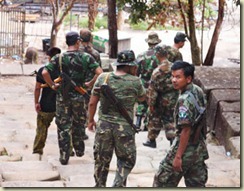
 The Thai and Cambodian soldiers killed in border clashes last weak were the latest victims of the two nations’ decades old dispute over ownership of the Preah Vihear Temple and its surroundings. Unfortunately, with both sides moving more troops toward the site they probably won’t be the last.
The Temple itself was built by Khmer Kings throughout the 11th and 12th centuries; but today’s controversy has its roots in the early 20th when France (Cambodia’s colonial ruler) and Siam (as Thailand was then known) drew out their mutual border. It was agreed that this would follow the watershed line of the Dângrêk mountain range –placing the temple on the Thai side; however the final map produced by the joint border commission in 1907 deviated from this, giving it to Cambodia.
The Siamese/Thai authorities never objected to this (later arguing that as physical access was only really possible from the Thai side, they had de-facto control anyway) but sent troops to occupy the site after France withdrew from Cambodia in 1954. Amid a rising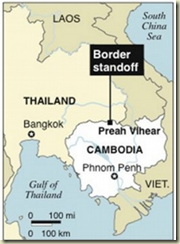 likelihood of armed conflict, the new Cambodian authorities brought a case to the International Court of Justice and in 1962 nine of the twelve judges ruled that – in light of numerous factors including Thailand’s longstanding acceptance of the map and thus ‘de-facto agreement’- Preah Vihear was legally Cambodian territory.
This resulted in a reluctant Thai withdrawal, leaving Preah Vihear an integral site in Cambodia’s ensuing civil conflict. It was both the final stronghold of the Republic as Pol Pot’s troops advanced; then the final stronghold of the Khmer Rouge and their tyrannical regime came down half a decade later. One of the site’s darkest moments then came in 1979 when Thai authorities deposited tens of thousands of Cambodian refugees there- shooting some, driving others over the nearby cliff and forcing them onto the minefields below. Conservative estimates put the dead at three thousand with some Cambodian sources suggesting as many as ten thousand. Relationships between the two nations- already fraught, plummeted to a new low.
 There was then, already a longstanding animosity by the time that fresh clashes began over the temple’s designation as a UNESCO World Heritage Site in 2008. Ironically this process began by bringing the neighbours closer together - with a joint communiqué issued in support of the move. However, things quickly soured when the Thai nationalist Yellow Shirt movement, angry that the designation would recognise Cambodia’s sovereignty, brought about Foreign Minister Noppadon Pattama’s resignation and led huge protests to the site. Dramatic government-orchestrated celebrations in Cambodia at the same time did not help tensions and troops were rapidly deployed to both sides of the border, where a succession of skirmishes left at least five soldiers dead. A continually high armed presence on either side has resulted in subsequent clashes each year – brining the death toll to well over twenty, with many more wounded and captured on either side.
All this leaves little hope that the uneasy ceasefire reached after this week’s fighting will hold. And whilst the precedent of previous clashes without recourse to war is a cause for optimism, other exacerbating developments such as the arrest of Thai nationalists by Cambodian authorities and disputes over offshore gas fields cannot be ignored. The biggest issue at play however, is the wave of protests by the Yellow Shirts demanding that the current Thai government is replaced with one who will take a harder line on the issue. Whilst Prime Minister Abhisit Vejjajiva looks secure for the time being, the Yellow Shirts have brought down a government before. Even if they don’t succeed in their ultimate goal therefore, Vejjajiva may be intimidated enough to ratchet up the pressure at Preah Vihear.
Such a delicate situation must be handled with care- as the consequences of armed conflict escalating beyond minor skirmishes will be devastating. Not only will the both armies see more casualties, but huge swathes of people will be displaced; last week alone some eight thousand living near the temple fled their homes. Beyond this, domestic political turmoil would almost certainly ensue on both sides of the border, increasing the human suffering. Meanwhile the already weak Association of South East Asian Nations will become only more impotent as two member states slog it out, most likely drawing in others.
This historic mountain temple is quickly becoming one of Thailand and Cambodia’s biggest challenges…and one of South East Asia’s biggest dangers.


