Showing posts with label South East Asia. Show all posts

Thursday, 7 April 2011

Thailand’s Unforgivable Crime

Two months on from the latest round fighting between Thailand and Cambodia over the 11th Century Preah Vihear Temple, Thai authorities have finally confessed what activists long suspected: they used cluster munitions during the conflict.

For those unaware of how these weapons work, the essence is as follows: a large shell releases dozens of smaller shrapnel-filled submunitions or ‘bomblets’ that scatter over a vast area, exploding and causing serious damage to anything in their vicinity.  The major problems with this are twofold: firstly those deploying the weapons have no control over their exact dispersal and secondlyCluster Bomb Submunitions many submunitions fail to explode on impact, yet remain live, effectively becoming landmines.  Thus whilst troops may utilise cluster munitions with no explicit intent of harming civilians, they cannot avoid ripping apart innocent people caught by stray bomblets or maiming farmers, children and other locals unfortunate enough to stumble across unexploded ones.

A sickening practical demonstration of the effects that cluster munitions produce long after fighting ends, is visible in Southern Lebanon where ‘bomblets’ dispersed by Israeli forces during their 2006 conflict with Hezbollah continue to claim the lives and limbs of Lebanese civilians, including youngsters who frequently mistake them for toys.  This tragic situation provided a key impetus for the Convention on Cluster Munitions – a treaty banning the weapons, which came into force last year after prolonged campaigning by groups such as the Cluster Munition Coalition.  Although this is only binding upon those states opting to ratify it, which currently number fifty-six and do not include either Thailand or Cambodia, it has nevertheless served to stigmatise the weapons and create a worldwide shift away from them.  Despite the protestations of states such as Israel and the USA, which respectively deem cluster munitions as “completely legal” and “legitimate”, Thailand’s deployment in February was the first and only since the Convention was originally opened to signatures in 2008.

Abhisit VejjajivaThis underscores the fast-and-loose attitude of Prime Minister Abhisit Vejjajiva and his administration towards human rights.  However, after deploying troops to murder protesters and allowing immigration authorities to cast refugees into the open sea, it is hardly surprising that they should add the inexcusable and unforgivable use of cluster munitions to their ever growing repertoire of abuse.  With an estimated 5000 Cambodians now at risk from the unexploded bomblets, the only way that the Thai government can begin to make amends for this specific act is to disclose all information concerning where the munitions were deployed and fund a clean-up operation…then sign the Convention on Cluster Munitions and destroy their remaining stockpile.  Nothing less is acceptable.

Sunday, 6 February 2011

Temple of doom

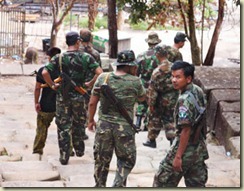
SoldiersThe Thai and Cambodian soldiers killed in border clashes last weak were the latest victims of the two nations’ decades old dispute over ownership of the Preah Vihear Temple and its surroundings. Unfortunately, with both sides moving more troops toward the site they probably won’t be the last.

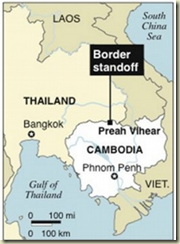
The Temple itself was built by Khmer Kings throughout the 11th and 12th centuries; but today’s controversy has its roots in the early 20th when France (Cambodia’s colonial ruler) and Siam (as Thailand was then known) drew out their mutual border. It was agreed that this would follow the watershed line of the Dângrêk mountain range –placing the temple on the Thai side; however the final map produced by the joint border commission in 1907 deviated from this, giving it to Cambodia.

The Siamese/Thai authorities never objected to this (later arguing that as physical access was only really possible from the Thai side, they had de-facto control anyway) but sent troops to occupy the site after France withdrew from Cambodia in 1954. Amid a risingPreah Vihear map likelihood of armed conflict, the new Cambodian authorities brought a case to the International Court of Justice and in 1962 nine of the twelve judges ruled that – in light of numerous factors including Thailand’s longstanding acceptance of the map and thus ‘de-facto agreement’- Preah Vihear was legally Cambodian territory.
This resulted in a reluctant Thai withdrawal, leaving Preah Vihear an integral site in Cambodia’s ensuing civil conflict. It was both the final stronghold of the Republic as Pol Pot’s troops advanced; then the final stronghold of the Khmer Rouge and their tyrannical regime came down half a decade later. One of the site’s darkest moments then came in 1979 when Thai authorities deposited tens of thousands of Cambodian refugees there- shooting some, driving others over the nearby cliff and forcing them onto the minefields below. Conservative estimates put the dead at three thousand with some Cambodian sources suggesting as many as ten thousand. Relationships between the two nations- already fraught, plummeted to a new low.

Preah Vihear fighting 2There was then, already a longstanding animosity by the time that fresh clashes began over the temple’s designation as a UNESCO World Heritage Site in 2008. Ironically this process began by bringing the neighbours closer together - with a joint communiqué issued in support of the move. However, things quickly soured when the Thai nationalist Yellow Shirt movement, angry that the designation would recognise Cambodia’s sovereignty, brought about Foreign Minister Noppadon Pattama’s resignation and led huge protests to the site. Dramatic government-orchestrated celebrations in Cambodia at the same time did not help tensions and troops were rapidly deployed to both sides of the border, where a succession of skirmishes left at least five soldiers dead. A continually high armed presence on either side has resulted in subsequent clashes each year – brining the death toll to well over twenty, with many more wounded and captured on either side.

All this leaves little hope that the uneasy ceasefire reached after this week’s fighting will hold. And whilst the precedent of previous clashes without recourse to war is a cause for optimism, other exacerbating developments such as the arrest of Thai nationalists by Cambodian authorities and disputes over offshore gas fields cannot be ignored. The biggest issue at play however, is the wave of protests by the Yellow Shirts demanding that the current Thai government is replaced with one who will take a harder line on the issue. Whilst Prime Minister Abhisit Vejjajiva looks secure for the time being, the Yellow Shirts have brought down a government before. Even if they don’t succeed in their ultimate goal therefore, Vejjajiva may be intimidated enough to ratchet up the pressure at Preah Vihear.

Such a delicate situation must be handled with care- as the consequences of armed conflict escalating beyond minor skirmishes will be devastating. Not only will the both armies see more casualties, but huge swathes of people will be displaced; last week alone some eight thousand living near the temple fled their homes. Beyond this, domestic political turmoil would almost certainly ensue on both sides of the border, increasing the human suffering. Meanwhile the already weak Association of South East Asian Nations will become only more impotent as two member states slog it out, most likely drawing in others.

This historic mountain temple is quickly becoming one of Thailand and Cambodia’s biggest challenges…and one of South East Asia’s biggest dangers.

cambodia_temple_dispute_hs107

Sunday, 16 January 2011

China’s Tajik land-grab

On Wednesday, shrouded in opaqueness and confusion, Tajikistan’s ruling regime ceded 1000km of the country’s Pamir Mountains region to China. The move generated only sparse media interest and was regarded in some quarters as nothing more than a corrupt dictatorship settling an old land-dispute with its powerful neighbour. However the true significance may be far deeper, revealing worrying signs about the Chinese government’s attitude to continued geographical expansion.

PamisThe precise facts of the transfer are still unclear, including exactly what has been handed over, how many people live there and what the change of sovereignty will mean to them. It is known that the final agreement relates to a disputed border and a deal struck some twelve years ago but that is where any consensus seems to end. Whilst the Tajik dictatorship is boasting of success, claiming that China originally sought almost twenty times as much land, opposition groups are objecting that the country’s territorial integrity and constitution have been debased. China, meanwhile is professing to have acted in accordance with international law, ironically a concept its leaders have ignored or openly dismissed countless times in the past. Interestingly, no one knows precisely what Tajikistan (or more accurately the Tajik political elite) got in return for the land, but owing to strong economic links between Beijing and Dushanbe, finance surely came into play. All uncertainties accounted for, when placing this affair in a broader regional context, it could have serious implications for South and South East Asian politics.

Of course the Chinese government’s land-grabbing is nothing new. It hardly needs to be reiterated how desperate the power-that-be in Beijing are to keep hold of occupied territories such as Tibet, East Turkestan and Inner Mongolia where systematic repression and cultural destruction have long been utilised to maintain control; but this is the first time in decades that China (as a state) has actually expanded its borders.

That is especially ominous considering the recently escalating tensions surrounding Chinese claims to disputed islands in the South China Sea. In 2010 territorial maritime spats with Vietnam, Brunei, the Philippines, Malaysia, and Indonesia were ratcheted up by provocative Chinese naval exercises and bizarre stunts including a submarine crew placing of a Chinese flag on a disputed sea bed. It was uncertain at the time whether these were simply displays of military bravado or the early throes of a concerted effort to tangibly increase geographic control, but this week’s acquisition of Tajik territory gives emphasis to the latter. Poignantly the barren, sparsely-populated and inhospitable nature of the Pamir Mountains suggest that the very principle of territorial expansion appeals to China’s leaders, creating a hugely precarious situation not only in the South China Sea but across the continent.

Perhaps the two most dangerous flashpoints will be Taiwan – regarded by China’s leadership as an integral part of Chines6e territory that should ultimately be reclaimed; and the China-India border where territorial disputes between the two countries led to military clashes as recently as 1987. These on-going issues will only be exacerbated by the China-India economic race and the anticipated breakdown in China-Taiwan relations should the pro-independence Democratic People’s Party win next year’s elections. Combine such factors with a Chinese-government desire for wider territorial control and you could have a recipe for political disaster.

Of course, it would be reckless to suggest that drums of war are beating but the ‘Tajik deal’ is China’s latest move in a pursuit of expansionist politics that will almost undoubtedly cause some degree turmoil in the region over the coming year. Who said the age of the empire was dead?

China

Monday, 4 October 2010

China's lapdog, Tibet's tormentor

On Tuesday thousands of Tibet supporters across the world will take to the streets; however, in a break from the norm, they will be converging on Nepalese embassies rather than Chinese ones. Their reason -captured in shocking footage by Radio Free Asia -is the confiscation of numerous ballot boxes for the election of the new Tibetan Prime Minister and Parliament in Exile, by armed Nepalese riot police in Kathmandu.

The order for the raids undoubtedly originated from Beijing and reflects two major political trends. Firstly, is the Chinese Government’s determination to disrupt this election, something that was already widely anticipated. In endorsing and encouraging the ballot, the Dalai Lama has shown himself to be the exact opposite of the despotic tyrant that the CCP portray him to be, so it is only natural they would want to scupper it. Furthermore, a democratically elected PM and Parliament with the unified support of the Tibetan community in exile will provide a legitimate and viable rallying point for the movement when the Dalai Lama is no longer here to provide his leadership and guidance. This too is a prospect that terrifies Hu Jintao and his fellow thugs.

The second and perhaps the wider reaching issue highlighted, is the level of China’s influence across South East Asia. The theft of the ballot boxes is merely the latest action of Nepal’s government in its role as China’s lapdog; following the
suppression of Tibetan protests and the closure of the Dalai Lama’s Kathmandu office. Naturally, given that it is home to the second largest exile Tibetan population in the world, China has invested considerable resources in courting and coercing successive Nepalese leaderships both before and after the collapse of its dictatorial monarchy.

Yet such behaviour extends far wider. The Chinese government’s
support of the Burmese junta prevents democracy and human rights from taking root on their doorstep; whilst their propping up of the North Korean regime (though partly for the practical reason of preventing the inevitable refugee influx should it collapse) allows further projection of their military and political muscle. Similarly a considerable degree of influence is held over Cambodia, from where China was able to successfully demand the return of twenty political asylum seekers last year, not to mention the communist-led states of Laos and Vietnam (both virtual black holes for human rights and civil liberties).

Ultimately, from the slaughter of protestors on the streets of Rangoon in 2007 (the bullets coming from Chinese guns), to the raid of polling stations in Kathmandu on Sunday (the orders coming from Chinese officials) – Beijing has exported its terror, tyranny and control across a huge swathe of South East Asia region in what now resembles something of a quasi-empire; bolstered further by its direct occupation of countries such as Tibet and East Turkestan.

However, every empire falls and one day -through the resistance of those in the region and their supporters across the globe- so too will this one.

Sunday, 25 April 2010

South East Asia: Ignore it at your peril

To anyone who's interested in foreign affairs last week's leaders debate was a let-down. Instead of ninety minutes of questions on the UK's place in the world, we were treated to 45 minutes on Afghanistan, Europe, climate change and (bizarrely, though not quite unexpectedly) the Pope - before the topic of conversation turned back to deficits, duck islands and the like.

Personally I'd been hoping for at least one question relating to South East Asia. Not just because it's a personal interest of mine but because it's a region that, over the next decade, is going to shape the world - and inevitably affect the UK - in ways that our politicians don't seem to head or even comprehend. Take the following scenarios....

1. The year is 2012- the political situation in Thailand has totally broken down, leaving the country in violent disarray. Next door in Burma civil war is raging between the ruling junta and ethnic rebel groups which were forced into conflict ahead of the 2010 election. This has left the Golden Triangle (one of the worlds largest heroin producing regions, spanning the Thai-Burma border) completely outside the control of any government and run by various militias. The inevitable price-wars that follow result in a flood of cheap heroin into the UK and Europe....

2. The year is 2015 -a continuing increase of ethnic and rural protests in China has begun to threaten the government's position. In a bid to generate national unity they order an invasion of the Senkaku Islands -an uninhabited territory of which both China and Japan claim ownership. Japan responds by pumping funds into its minimalist military and deploying war ships. Vietnam- which has its own island disputes with China - also deploys vessels. The US is more worried about Taiwan and puts its navy -currently stationed in the Taiwan straits - on high alert. India- which had fought several border wars with China and still disputes inland territory- mobilises its army. China responds in kind. Tension mounts....

3. The year is 2020 - Burma's nuclear programme (supported by Russia and North Korea) has come to fruition. Isolated and impoverished the erratic regime opts to sell the plutonium it produces to the highest bidder. The world reacts with panic as rumours of contact with terrorist groups spread. The solution is not clear- Burma is firmly within China's sphere of influence and any military action would surely antagonise the Chinese government. But Beijing seems to have little control over the regime's next move....

4. The year is 2025 - the effects of climate change, exacerbated by the Chinese government's damming projects in Tibet, have led to major water shortages in Bangladesh. Thousands of refugees head across the border into India- now one of the world's economic power houses - generating ethnic tensions and threatening the state's stability. Foreign businesses begin to withdraw a rate that threatens to trigger global economic chaos...

These aren't scare-stories: they are all very possible, even (in some cases according to some commentators) likely. The world's engagement with China, approach to the ongoing crisis in Burma, reaction to increasing violence in Thailand and stance on the occupation of Tibet is not just important because of the human costs today - but because of the huge political effects (for the whole world) tomorrow. Often it seems that Western government leaders ignore South East Asia....they do so at their peril.